
Measured support for difficult ground.
Provenance coordinates soil information, structural loads, pile selection, installation depth, torque records, and pile-head connections as one engineered foundation strategy for demanding custom-home sites.
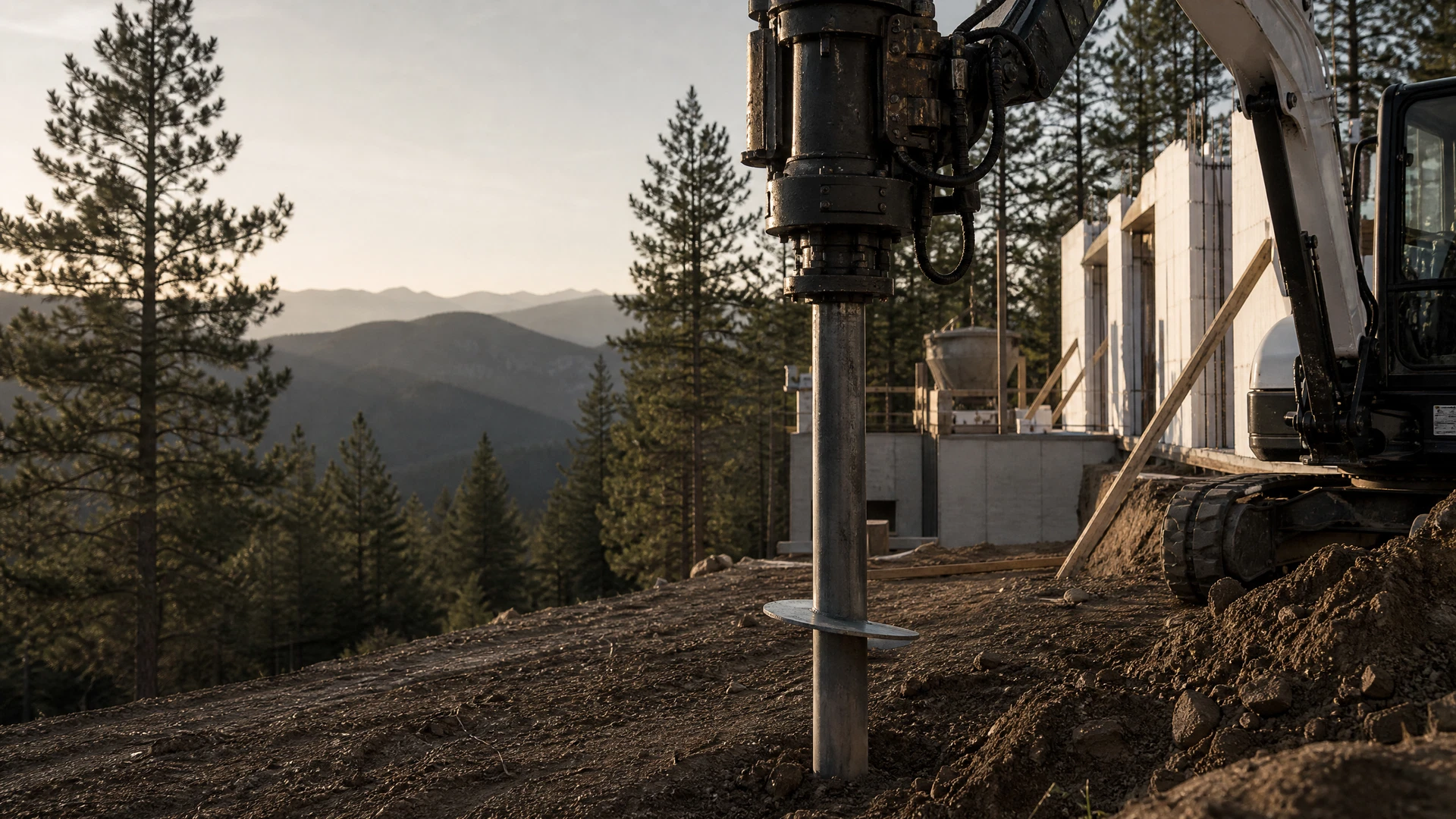
Design intent that stays visible during installation.
A helical pile is a manufactured steel deep-foundation element with one or more helical bearing plates. It is advanced into the ground with rotational torque, extended to the specified depth and resistance criteria, then connected to the structure through an engineered cap or bracket.
Its usefulness is not that it avoids engineering. It is that soils, loads, product selection, installation depth, torque records, and the structural connection can remain connected from design through the field record.
Three records that keep the load path visible.
Pile-by-pile record
Depth, final torque, shaft configuration, equipment, and exceptions are captured for each installed element—not averaged across the site.
Paired criteria
Depth and torsional resistance work together inside the engineer’s acceptance criteria and the selected system’s rated limits.
Load-path closeout
The pile head, cap, bracket, grade beam, and supported structure complete the system. Installation is not finished at the ground line.
A foundation element with a measurable installation story.
Shaft, helices, extensions, connections, and installation criteria are selected as one engineered system. The exact configuration belongs to the project—not to a generic detail.
Central shaft
A manufactured steel shaft sized for structural loads, installation torque, slenderness, and the selected system.
Helical bearing plates
One or more formed steel plates selected for the soil profile, installation behavior, and required resistance.
Extensions and couplings
Sections that advance the pile to the specified bearing condition while transferring installation and structural demands.
Pile head or bracket
The engineered interface between the installed pile and footing, grade beam, column, addition, or other supported element.
Depth and torque criteria
Field targets established by the registered design professional within the selected manufacturer’s limits.
Installation record
Documented depth, torque, equipment, pile configuration, and exceptions for each installed element.
Why teams evaluate helical piles.
The strongest case is site-specific. Helical piles can offer a controlled alternative when conventional excavation, near-surface bearing, access, or disturbance creates a difficult foundation problem.
Measured field criteria
Depth and installation torque can be recorded against the engineer’s criteria as part of the installation record.
Focused site disturbance
Compact installation equipment and a smaller excavation footprint can be useful on selected constrained or sensitive sites.
Compression and uplift
Engineered systems can be configured for project-specific compression and uplift demands when soils and connections support the approach.
Direct structural connection
Designed caps, brackets, and grade-beam interfaces make the load path explicit from the building into the deep-foundation system.
Where helical piles earn consideration.
A geotechnical and structural review should test the method against alternatives. The right answer may still be conventional footings, over-excavation, ground improvement, micropiles, driven piles, or another engineered system.
Weak or variable near-surface soils
Sloped or access-constrained custom-home sites
Selected waterfront or high-groundwater conditions
Additions near existing structures
Foundation elements with uplift demands
Projects where limited excavation may protect the site strategy
Torque is evidence. Engineering makes it meaningful.
The installation record matters only when it is tied to the soil profile, design loads, evaluated system, equipment, depth criteria, manufacturer limits, and connection design.
Read the ground
Characterize soil type, density, seasonal influence, groundwater, obstructions, target strata, access, and installation risk.
Define the loads
Coordinate compression, uplift, lateral demand, settlement criteria, reactions, load combinations, and the supported structure.
Select the system
Engineer shaft, helix configuration, corrosion protection, couplings, installation equipment, and pile-head connection.
Install and record
Advance each pile to the specified depth and torsional-resistance criteria without exceeding the system’s rated installation torque.
Verify and connect
Review logs and any specified testing, then complete the documented structural interface to footing, beam, bracket, or column.
Not every difficult site is a helical site.
Cobbles, boulders, very dense layers, limited headroom, high lateral demands, buckling, corrosion exposure, utilities, access, and unsuitable target strata can change or eliminate the option. Capacity cannot be inferred from torque alone. The selected system, geotechnical information, structural design, manufacturer requirements, installation record, and any specified testing must agree.
Start with the right questions.
01What is a helical pile?
A helical pile is a manufactured steel deep-foundation element with one or more helical bearing plates. It is installed by rotational torque and connected to the structure through an engineered cap or bracket.
02When are helical piles considered for a custom home?
They are evaluated when loads, soils, slope, access, excavation, additions, uplift, or waterfront constraints justify a deep-foundation alternative. Geotechnical information and structural engineering determine fit.
03Does installation torque prove pile capacity?
Not by itself. Torque correlation can be one code-recognized capacity method, but it must be used within the engineered system, specified depth, manufacturer rating, soil information, installation record, and any required verification testing.
04Can helical piles be installed near an existing structure?
They can often be considered for additions or constrained sites because equipment may be comparatively compact. Access, headroom, reactions, utilities, obstructions, and connection design remain project-specific.
05What happens if installation encounters boulders?
Cobbles, boulders, or dense layers can obstruct installation or require a different shaft, helix configuration, location, predrilling strategy, or foundation system. The risk should be addressed during geotechnical review and preconstruction.
06Are helical piles less expensive than conventional foundations?
Sometimes, but not universally. Quantity, depth, loads, soil, steel system, mobilization, testing, caps, grade beams, and the alternatives must be priced as complete systems.
Bring the soil information and foundation reactions to the table.
Tell us where the project stands, what the site is asking of it, and what you want the building experience to protect.
Start a project